
Spanish Citizenship by Democratic Memory Law 2026: Closed Window and Pending Cases
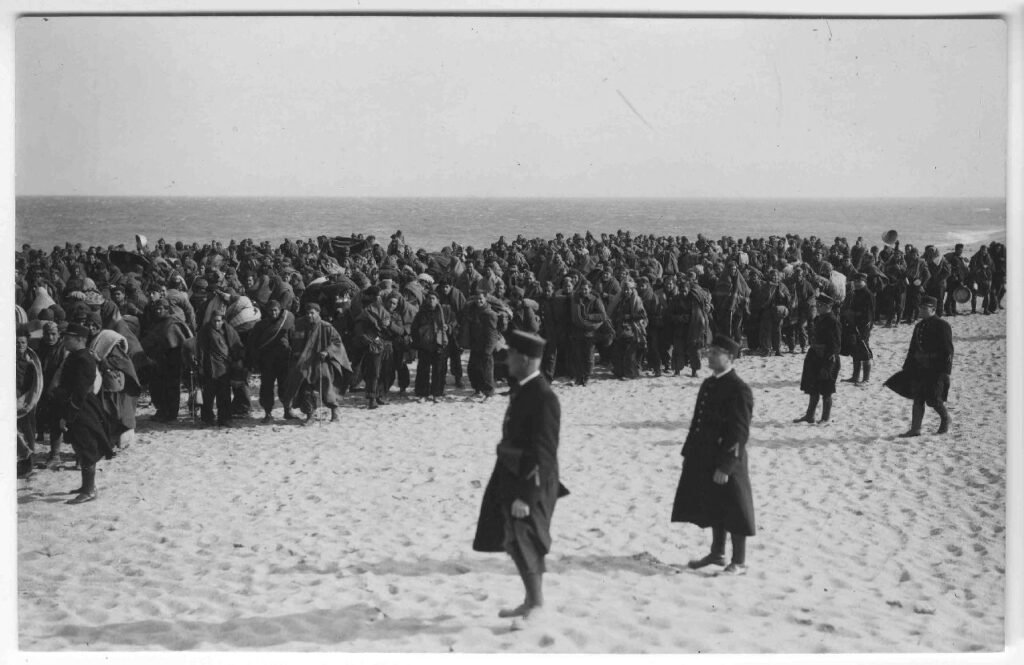
Historical photograph: Spanish Republican refugees at Le Barcares, March 1939. Albert Belloc / Archives departementales des Pyrenees-Orientales, via Wikimedia Commons. CC BY-SA 4.0. Resized for display.
The Ley de Memoria Democrática (Law 20/2022), also known as the “Grandchildren Law” (Ley de Nietos), created a temporary right to opt for Spanish nationality. The application window closed in October 2025; it is not generally open to new applicants in 2026. This does not end every pending case: applications lodged in time can continue, and qualifying consular appointment requests made in time can lead to personal submission after the deadline. The official rules and the competent consulate’s notice determine whether that protection applies.
Who Was Eligible?
The categories below describe the temporary option under Additional Provision Eight of Law 20/2022, as interpreted by the Instruction of 25 October 2022. Meeting a family-history condition alone does not establish that a new application can be submitted now.
- People born outside Spain to an originally Spanish parent or grandparent: The instruction distinguishes this category from cases where that ancestor lost or renounced Spanish nationality because of exile for political, ideological, religious, sexual-orientation or gender-identity reasons. Proof of exile is not a universal requirement for every applicant under Annex I.
- Children born abroad to Spanish women who lost their Spanish nationality by marrying a foreigner before the 1978 Constitution entered into force.
- Adult children of Spaniards whose nationality of origin was recognised through the option under either the 2022 Democratic Memory Law or Additional Provision Seven of the 2007 Historical Memory Law.
- Certain people who had already acquired non-origin Spanish nationality by option: The instruction also provided an Annex IV route for the specified Article 20.1.b cases and Article 20.1.a cases involving children of people who acquired nationality under the 2007 law. This was subject to the temporary window, not a permanent reopening.
The nationality acquired under this scheme is Spanish nationality of origin acquired subsequently, with effects from acquisition, not retrospectively from birth. A Spanish great-grandparent alone does not establish a direct entitlement: the applicable category, intervening family relationships and each person’s procedural position must be assessed.
Required Documents
For a pending case or a protected appointment, use the form and document list for your category, not a universal Annex I checklist. The instruction specifies:
- Identity and birth: A document proving the applicant’s identity and a literal birth certificate from the local Civil Registry where the birth is registered.
- Parent or grandparent route: The originally Spanish ancestor’s literal birth certificate and, when applying through a grandparent, the intervening parent’s literal birth certificate. If no birth registration exists, the instruction provides alternatives such as a baptismal record together with a negative registration certificate.
- Spanish mother’s marriage route: Her literal birth and marriage certificates. For marriages from 5 August 1954 to 28 December 1978 inclusive, additional evidence of acquisition of the husband’s nationality and the relevant foreign law is required.
- Adult-child route: Evidence of the parent’s nationality acquired under the 2007 or 2022 law. The instruction requires the parent’s Spanish literal birth certificate when the application is made at a different Civil Registry from the one holding that birth registration.
- Exile evidence, where relevant: Apply the evidential rules below rather than treating a passenger list or an association record alone as sufficient in every case.
- Correct form and timely-request evidence: Annex I, II, III or IV as applicable, together with the filing receipt or the qualifying consular appointment-request acknowledgement. Follow the competent office’s instructions for originals and copies.
Under the instruction, exile is presumed for Spaniards who left Spain between 18 July 1936 and 31 December 1955, but departure must still be proved. For departures from 1 January 1956 to 28 December 1978, exile must be established. Spanish exile-pension evidence can prove exile by itself; the specified refugee-office or recognised organisation records must be combined with qualifying evidence of arrival or residence. These are rules for cases relying on exile, not a reason to impose exile evidence on every family-history category.
Foreign registry certificates require legalisation or an apostille as applicable, subject to international treaties. Documents not in Spanish require an official translation by a competent body or official. The office may request additional evidence; do not assume every document needs both legalisation and an apostille, or that a Spanish-language certificate needs translation.
Application Process
- Check the procedural position first: Identify whether the application was lodged in time or whether a qualifying consular appointment request preserves later personal submission. An informal enquiry or merely gathering documents does not by itself establish this protection.
- Use the competent Civil Registry: The instruction refers to the office for the applicant’s domicile, including the relevant consular office abroad, with applicable registry-competence and forwarding rules. Living in Spain does not make Madrid the universal filing office.
- Attend and document the protected appointment: Where the consular exception applies, present the application personally on the assigned date with the required original documents and the acknowledgement proving the timely appointment request. Follow that consulate’s credential and booking procedure.
- Respond to requests and complete the option formalities: The instruction provides 30 calendar days from a request to complete missing proof, including for protected consular appointments. Follow the notice received and the applicable oath or promise and registration requirements; no approval or 6–18 month processing time is guaranteed.
- Obtain evidence of registration before the passport stage: A pending application or appointment receipt is not a Spanish passport or proof that nationality has already been acquired. After acquisition and registration, follow the competent consulate’s or Spanish police authority’s passport requirements.
Has the Democratic Memory Law been extended to 2026?
No. The application window closed in October 2025; there is no general new application window in 2026. Pending applications and qualifying appointment requests are distinct from an extension. Law 20/2022 entered into force on 21 October 2022 and provided a two-year window, with a possible one-year extension. The Council of Ministers agreement of 9 July 2024 approved that additional year. It did not create a general application window for 2026.
Check the actual consular notice when assessing a request made around the closing date. The current official notice for London states that appointment requests closed on 22 October 2025 at 23:59 and that no new requests are accepted from 23 October. This notice must not be replaced by an assumed universal 21 October cut-off or used to infer identical booking arrangements at every consulate.
The Instruction of 5 November 2024 establishes the consular exception: where an appointment could not be attended within the statutory window, but was requested in time through the designated electronic tools that verify identity and generate proof of the request date, the applicant may submit personally later on the assigned date, bringing that proof. It is not an unrestricted right to start a new application after closure. Keep the acknowledgement and subsequent instructions; confirm with the competent office whether your particular receipt meets the requirements.
Applications lodged in time may continue to be processed after the window closes. Closure does not itself reject every pending file, but neither a pending file nor a protected appointment guarantees eligibility or approval. If no timely application or qualifying appointment request exists, seek an assessment of any separate nationality route rather than assuming this temporary scheme remains open.
Pending appointment or pending application: what should you check?
Identify which stage your documents actually prove: an appointment-request acknowledgement records a request and its date; credentials provide access to the consulate’s booking system; an assigned appointment confirms when to attend; and a filing receipt or case reference relates to an application already lodged. Keep each document and the office’s subsequent instructions. A request acknowledgement or booking confirmation is not proof that nationality has been approved.
For London specifically, the Consulate’s notice of 1 October 2025 explains that the electronically signed appointment-request confirmation with a Secure Verification Code (CSV) is essential for later personal submission. It says credentials will follow so the applicant can book an appointment, advises retaining access to the email account and checking spam, and warns of possible delays in credentials and decisions. Its instructions to request or re-request an appointment before the October 2025 deadline are historical, not a new opportunity to apply now.
For follow-up, use the official instructions and contact channel of the office handling your request or file, quoting the reference it issued. London’s CSV and booking arrangements must not be assumed to apply at every consulate. Neither the notice nor these stages provides a guaranteed decision date or a universal Democratic Memory Law tracking portal.
Missed the deadline: which other routes should you assess?
If you have no timely application or qualifying appointment request, assess other routes to Spanish nationality according to your nationality by origin, family relationship and residence history. A Spanish ancestor or marriage alone does not establish an automatic entitlement. If residence is the relevant alternative, see the citizenship by residence requirements: the qualifying residence period and other conditions depend on the individual statutory category. These are separate routes, not a reopening of the Democratic Memory Law.
FAQs
Can I keep my original nationality?
For this Democratic Memory Law option, the Spanish implementing instruction exempts applicants from the declaration renouncing their previous nationality. That does not determine the effect of acquiring Spanish nationality under the other country’s law. Check that country’s retention or loss rules before assuming dual nationality is guaranteed.
Contact Elena Mochales to verify your eligibility under the Democratic Memory Law.

This content is for informational purposes only and does not constitute legal advice. Each case is unique. Consult with a qualified immigration lawyer for advice tailored to your situation.