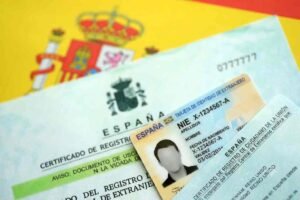
TIE Card Spain 2026: Complete Application Guide

Key takeaways
- The TIE (Tarjeta de Identidad de Extranjero) is the physical residence card for non-EU nationals and shows your NIE.
- Apply in person at the Oficina de Extranjería or a designated police station within one month of entering Spain or of your authorisation taking effect.
- The fee is €16.08 (modelo 790-012) with form EX-17; the card is usually ready within 30–45 days.
Need help with your case? Elena Mochales (ICAM C69993) is a Barcelona-based immigration lawyer working online with clients worldwide in English, Spanish and Arabic. Book a consultation →
The TIE card (Tarjeta de Identidad de Extranjero) is the physical identification document issued to non-EU nationals who obtain legal residency in Spain. Issued by the Spanish National Police, it contains your NIE number (Número de Identidad de Extranjero), photograph, fingerprint, and residency details. Under the general immigration regime, a TIE is required for an authorised stay or residence of more than six months, subject to statutory exceptions. Apply within one month of entry into Spain or of the authorisation being granted or taking effect, as applicable; in some work-permit cases, the trigger is Social Security registration. See Article 209 of RD 1155/2024 and Article 4 of Organic Law 4/2000. The card serves as proof of legal residency and is required for everything from opening a bank account to enrolling in public healthcare. As of 2026, the application process uses the EX-17 form, requires an in-person appointment at a Foreigner’s Office (Oficina de Extranjería) or designated police station, and costs €16.08 via the modelo 790-012 fee form. This guide, prepared by Elena Mochales, covers current 2026 requirements, required documents, the complete appointment process, processing times, renewals, and the most frequent application errors that cause unnecessary delays.
Quick Summary: TIE Card Spain 2026
| Who needs it | General regime: authorised stay or residence over six months; statutory exceptions apply |
| Where to apply | Oficina de Extranjería or designated National Police station |
| When to apply | Within one month of entry, grant or effectiveness of the authorisation, depending on the applicable route |
| Cost (2026) | €16.08 — modelo 790-012 fee form |
| Required form | EX-17 (Solicitud de Tarjeta de Identidad de Extranjero) |
| Processing time | 30 to 45 calendar days from the application date |
| Validity | Matches the duration of your residence permit |
What Is the TIE Card and Who Needs It in 2026
The TIE card (Tarjeta de Identidad de Extranjero) is a credit-card-sized physical ID document that proves your legal residency status in Spain. It documents the holder’s authorised stay or residence; it does not itself grant the underlying right. See the National Police TIE information. The card includes your full name, NIE number, nationality, date of birth, photograph, fingerprint, and the specific type of residence authorization you hold.
For students under the general regime, the TIE requirement concerns an authorised stay of more than six months, not merely a course longer than 90 days. Article 4.2 of Organic Law 4/2000 exempts holders of a seasonal residence-and-work visa and allows specific rules for cards linked to shorter authorisations; check the rules for your category rather than treating the six-month threshold as universal. EU/EEA citizens follow the separate EU registration certificate procedure, not the TIE procedure. Their non-EU family members have a separate residence-card procedure.
You must apply for the TIE card in person at the Oficina de Extranjería or designated police station in the province where you are registered (empadronamiento). Applications through third-party representatives are permitted only in cases of minors or legal incapacity, with proper documentation.
TIE Card Requirements and Required Documents 2026
The document checklist for a TIE card application in 2026 varies slightly depending on your residence type. Below is the core set of documents required for all applicants, followed by additional items specific to each residency category.
Core documents for all applicants:
- EX-17 application form — completed and signed. Download from the Ministry of Inclusion official website.
- Valid passport — original and a photocopy of all pages containing data or stamps.
- Empadronamiento certificate — issued within the last 3 months by your local town hall (ayuntamiento).
- Three recent passport-size photographs — white background, 32×26 mm, taken within 30 days.
- Proof of payment of the tasa 790-012 — €16.08 fee form, completed and paid at a bank or online.
- Residence authorization resolution — the official document granting your residence permit.
- Appointment confirmation — printed or digital copy of your cita previa.
Additional documents by residency type: student visa holders must present proof of enrollment and health insurance; work permit holders need the employment contract and Social Security registration number; non-lucrative visa holders provide proof of financial means and private health insurance; family reunification applicants include marriage or birth certificates translated and apostilled; digital nomad visa holders submit the teleworking contract and proof of professional activity.
Step-by-Step TIE Card Application Process
Follow these six steps to obtain your TIE card in Spain. The process takes approximately 30 to 45 days from the appointment date to physical card delivery.
Step 1 — Obtain your residence authorization. Before you can apply for the TIE, you must have an approved residence permit or a visa that explicitly grants residency. This authorization is processed either at the Spanish consulate in your home country or, for renewals, at the Oficina de Extranjería in Spain.
Step 2 — Register your empadronamiento. Visit your local ayuntamiento with your passport, rental contract or property deed, and a utility bill in your name. The certificate is free and issued immediately in most municipalities. You need this before booking the TIE appointment.
Step 3 — Complete and pay the tasa 790-012. Download form 790-012 from the Spanish tax agency website. Fill in your NIE number, name, and address. Select the option “Certificado de registro de residente comunitario o Tarjeta de residencia” and pay €16.08 at a collaborating bank (Santander, BBVA, CaixaBank, Sabadell) or electronically if you have a digital certificate.
Step 4 — Book your cita previa. Appointments are booked through the Sede Electrónica de Extranjería. Select your province, choose “Policía — Toma de huellas (expedición de tarjeta)” from the menu, and enter your NIE number. Available slots are released at irregular times — if none appear, check early morning or late at night.
Step 5 — Attend your appointment. Arrive 15 minutes early with the complete document set. At the station, an officer will review your paperwork, confirm your identity, capture your fingerprints electronically, and take a digital photograph. The physical TIE card is not issued on the same day — you will receive a resguardo (receipt) for the card application. Do not treat this receipt as a travel document; see the travel FAQ below.
Step 6 — Collect your TIE card. Return to the same office 30 to 45 days later to collect your card. You must bring the resguardo and your passport. Some offices send an SMS notification when the card is ready; others require you to check online using your NIE and the reference number on the resguardo.
Practical example: A US citizen arrives in Barcelona in September 2026 under the non-lucrative visa program. After receiving the visa stamped passport at the Barcelona consulate, they register their empadronamiento at the Eixample district office (30 minutes, same day). They complete and pay the tasa 790-012 at a CaixaBank branch (€16.08). A cita previa is booked at the Barcelona Rambla Guipúscoa police station three weeks later. At the appointment, they present the EX-17 form, passport copies, empadronamiento, three photographs, the paid tasa, and the visa resolution — the officer takes fingerprints and issues a resguardo. Thirty-two days later, they receive an SMS and collect the TIE card with their passport and resguardo.
NIE vs TIE: Key Differences
The NIE (Número de Identidad de Extranjero) and TIE (Tarjeta de Identidad de Extranjero) are frequently confused. The NIE is an identification number, not permission to live or work in Spain. The TIE is the physical document containing that number and evidencing legal status; the underlying authorisation or recognised right determines the right to stay, reside and, where applicable, work. Understanding this distinction prevents administrative mistakes.
| Feature | NIE | TIE Card |
|---|---|---|
| What it is | A unique identification number (X-1234567-X) | A physical biometric card with photograph and fingerprint |
| Who needs it | Any foreigner conducting economic or legal activities in Spain | General regime: authorised stay or residence over six months; statutory exceptions apply |
| Physical format | Number shown on documents, including NIE certificates, EU registration certificates and TIE cards | Plastic card identical in size to a DNI or credit card |
| Expires | No — the NIE number is permanent and never changes | Yes — validity matches the residence permit duration |
| EU citizens | Use the EU registration certificate procedure, not a TIE application | EU citizens do not receive a TIE |
| Cost | €10.72 (modelo 790-012 for NIE assignment) | €16.08 (modelo 790-012 for TIE issuance) |
| Appointment type | Asignación de NIE at Policía Nacional | Toma de huellas at Oficina de Extranjería or police station |
For a detailed breakdown of the NIE application process, read our How to Get an NIE in Spain: 2026 Step-by-Step Guide. For a comprehensive comparison of both documents, visit the NIE & TIE Guide Spain 2026.
TIE Card Renewal and Expiration
Your TIE card has an expiration date displayed on the front of the card. It matches the duration of your residence authorization. Renewal deadlines depend on the authorisation type. For non-lucrative residence, Article 64 provides for filing during the two months before expiry, or within the three months afterwards without prejudice to possible sanction proceedings. Do not treat calendar months as a fixed number of days or apply this route’s rules to every TIE holder.
The renewal process follows the same steps as the initial application: submit the residence renewal application through the Oficina de Extranjería (EX-01 for renewals, not EX-17), obtain a favorable resolution, pay the new tasa 790-012, book a fingerprint appointment, and collect the updated card. You must bring your expired TIE card to the appointment — it will be retained and replaced. The renewal fee in 2026 is the same €16.08. Processing time for renewals is 30 to 45 days, identical to the first-time application window.
Extension of an existing authorisation during renewal depends on the applicable renewal rules, not on waiting three months or obtaining a fingerprint receipt. For example, Article 64 on non-lucrative residence renewal links the extension to filing the renewal application within the specified period, until a decision is made. This does not turn the fingerprint receipt into permission to travel within Schengen; see the travel FAQ below.
Common Application Mistakes and How to Avoid Them
Applications are rejected or delayed most frequently due to the following avoidable errors. Review this list before your appointment.
- Booking the wrong appointment type. Select “Policía — Toma de huellas (expedición de tarjeta)” — not “Asignación de NIE” or “Renovación de tarjeta de larga duración” unless your case matches those categories exactly. Booking the wrong type means arriving at the office and being turned away.
- Photographs that do not meet specifications. Spanish authorities enforce strict photo requirements: 32×26 mm, white background, no glasses, no smiling, ears visible, taken within 30 days. Photos rejected at the appointment require rescheduling.
- Expired empadronamiento certificate. The padrón certificate has a 90-day validity window from the date of issue. If your certificate exceeds this period, request a new one before the appointment.
- Incorrect tasa 790-012 form. The form offers multiple payment options. Select the correct one: “Certificado de registro de residente comunitario o Tarjeta de residencia” for first-time applications and standard renewals. Payment must be completed before the appointment.
- Missing passport page copies. Photocopy every page of your passport that contains stamps, visas, or personal data — not just the biographical page. Incomplete copies are the single most common reason for same-day rejection.
- Missing the applicable one-month deadline. The general deadline is one month, not exactly 30 calendar days. It runs from entry into Spain, the grant of the authorisation or its taking effect, as applicable, including Social Security registration where required. For initial non-lucrative residence, Article 63.5 specifies one month from entry into Spain. Failure to comply with TIE obligations is subject to the statutory sanctions regime; seek case-specific advice if you are late. See Article 63.5 and Article 209.
Frequently Asked Questions
What is the difference between a NIE and a TIE card?
The NIE is a foreigner identification number, not a residence authorisation. The TIE is a physical identity card containing the NIE and evidencing the holder’s legal status. The underlying authorisation or recognised right, not the number or card alone, determines permission to stay, reside and, where applicable, work. EU/EEA citizens use the separate registration certificate procedure, not a TIE.
How long does it take to get a TIE card in Spain in 2026?
The complete process from appointment to card collection takes 30 to 45 calendar days. The initial appointment itself lasts 15 to 20 minutes. You receive a resguardo (receipt) for the card application; it is not, by itself, permission to travel or re-enter Spain.
Can I travel within the Schengen area while waiting for my TIE card?
Do not rely on the fingerprint receipt (resguardo) and passport alone as permission to travel within Schengen or re-enter Spain. The receipt is not an autorización de regreso. For a residence or stay authorisation under renewal or extension, a return authorisation may be issued if the renewal or extension was applied for within the legal deadline. For an approved initial authorisation, it requires evidence of necessary travel and exceptional reasons; approval alone is not enough. The return authorisation is valid for re-entry through authorised Spanish border crossings, not as a general permit to travel through other Schengen countries. Check your valid visa or residence documents and the destination and transit requirements before travelling. See the National Police return-authorisation conditions and Article 5 of RD 1155/2024.
What happens if I miss the applicable deadline to apply for the TIE card?
The general deadline is one month, not exactly 30 calendar days. It runs from entry into Spain, the grant of the authorisation or its taking effect, as applicable, including Social Security registration where required. For initial non-lucrative residence, Article 63.5 specifies one month from entry into Spain. Failure to comply with TIE obligations is subject to the statutory sanctions regime; seek case-specific advice if you are late. See Article 209 and Article 63.5 for non-lucrative residence.
Is the TIE card process the same in all Spanish provinces?
The legal framework is national, but operational details vary. Larger provinces (Madrid, Barcelona, Valencia, Málaga) have multiple offices and higher appointment availability. Smaller provinces may have a single office with limited cita previa slots. Some offices require the tasa to be paid before the appointment; others accept payment at the premises. Always verify the specific requirements of your local Oficina de Extranjería before attending.
Get Professional Help with Your TIE Card Application
Preparing a complete and correct TIE card application reduces processing time and eliminates the risk of rejection. At Elena Mochales, our immigration law team handles the entire process: document verification, form preparation, tasa payment coordination, appointment booking in high-demand provinces, and follow-up until card collection. We also assist with appeals for rejected applications and late-filing regularization. Book a consultation here to discuss your case.
Disclaimer: This article provides general information about the TIE card application process in Spain as of 2026. It does not constitute legal advice. Immigration procedures are subject to regulatory changes, and individual circumstances affect eligibility and processing. For case-specific guidance, consult a qualified immigration lawyer. Elena Mochales Abogada accepts no liability for actions taken based on this information.

This content is for informational purposes only and does not constitute legal advice. Each case is unique. Consult with a qualified immigration lawyer for advice tailored to your situation.